Research | Publications

Research | Publications

Here you will find research results and publications on our most important topics.

Private Course
Please sign in to contact responsible.
Responsible Vanessa Petzold
Last Update 07/01/2024
Completion Time 2 days 6 hours
Mitglieder 18
Research Area: Learning Enhancement - Children and Youth
View all
Research area: Language acquisition | FLIC
View all
Elternkatalog
Elternkatalog
Preview
Flyer und Broschüren
Research area: adults basic education
View all
AlphaPlusJob Arbeitsplatzbezogene Alphabetisierung
Preview

aus: ALFA-FORUM 85 (Frühjahr 2014) – Zeitschrift des Bundesverbandes Alphabetisierung und Grundbildung e.V.

ESP-3-2013  (englisch publication)
ESP-3-2013 (englisch publication)
Preview

Evaluation of a new training programm to improve the reading and working skills of functional illiterates

Was Analphabeten hilft
Preview

Bild der Wissenschaft 12-2011 Löcher-Bolz

Research area: HEARING TRAINING
View all
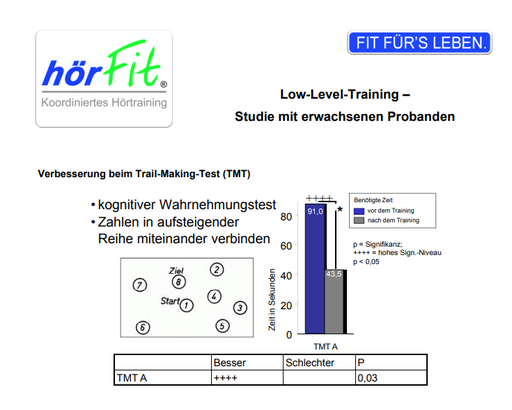
Low-Level-Training
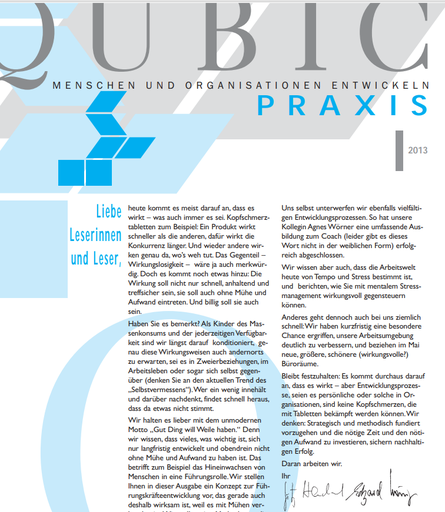
QUBIC Praxis
QUBIC Praxis
Preview

HEARING ALSO TAKES PLACE IN BETWEEN THE EARS

Kostka Rostock 2009
Kostka Rostock 2009
Preview

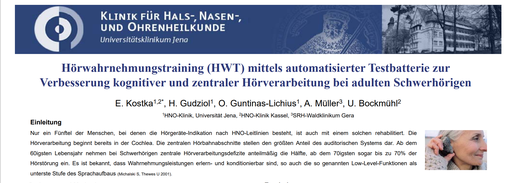
Hearing Perception Training (HWT) using an automated test battery to improve cognitive and central hearing processing in adult hearing impaired people

Research area: Bio- und Neurofeedback
View all
Research area: Tinnitus
View all
Tinnitus therapy with the Warnke method
Preview

from: Tinnitus Forum (2-2008)
by W. Scholtz

Slow Cortical Potential Neurofeedback in Chronic Tinnitus Therapy: A Case Report
Preview

Keywords: Tinnitus therapy; Slow cortical potential Neurofeedback; quantitative electroencephalography
An Official Journal of PMC
www.ncbi.nlm.nih.gov
TECHNICAL NOTE
The full article can be obtained here:
https://www.ncbi.nlm.nih.gov/pmc/articles/PMC4856729/pdf/10484_2015_Article_9318.pdf

Research area: Balance | Coordination
View all
Balance Testing in Multiple Sclerosis-Improving Neurological Assessment With Static Posturography?
Preview

Balance problems can severely limit the quality of life for people with Multiple Sclerosis (pwMS) already in the early stages of the disease. PwMS are usually assessed with the Expanded Disability Status Scale (EDSS), which includes a Romberg test for assessing balance. As the EDSS assessments are subjective to the examining neurologist, the postural stability of pwMS could be objectively quantified by implementing static posturography to detect balance problems and address preventive medical care

Validity and Reliability of Limits-of-Stability Testing: A Comparison of 2 Postural Stability Evaluation Devices
Visual Feedback and Postural Control in Multiple Sclerosis
Preview

Abstract: As people with multiple sclerosis (pwMS) manifest heterogeneous demyelinating lesions
that could affect somatosensory or vestibular ways, visual stimulus as feedback could be especially
relevant to achieve postural control. This has clinical importance for the development of preventive
measures and rehabilitation therapies in order to avoid falls and accidents in this group. In our study,
we objectively evaluated the influence of visual feedback on the stabilization of balance in pwMS
versus healthy controls (HC) and its potential utility in clinical evaluation. Static posturography tests
were performed in 99 pwMS and 30 HC. Subjects stood on a force platform with open and closed
eyes. During this procedure, three balance parameters were obtained for both vision conditions:
average sway, average speed, and average speed of sway. Neurostatus-Expanded Disease Disability
Score (EDSS) and Multiple Sclerosis Functional Composite (MSFC) were performed in parallel as
well. A two-way mixed repeated measures ANCOVA, controlling for sex and age, was performed
to evaluate the effect of vision, MS diagnosis, and the interaction of both in static posturography
parameters. The difference between both closed and open eyes conditions was calculated for each
parameter and further analyzed according to MS-relevant clinical variables. The magnitude of the
vision effect differed between pwMS and HC as a significant interaction between the vision and the
MS diagnosis in the delineated area (p < 0.001) and average speed of sway (p = 0.001) was seen.
These parameters had a greater increase in pwMS than in HC after closing eyes. For the average
sway, a significant main effect of vision was present (p = 0.047). Additionally, the differences obtained
between open and closed eyes conditions assessed with the delineated area and average speed of sway
were moderately correlated to the assessed clinical tests EDSS (r = 0.405 and r = 0.329, respectively)
and the MSFC (r = −0.385 and r = −0.259, respectively). In our study, pwMS were more dependent
of visual feedback than HC to maintain postural control. This easy and short evaluation by static
posturography could support the development of targeted preventive measures and interventions
in pwMS

To the MediBalance PRO product page.

All the information about our balance system.